The hidden sequences of Pascal’s triangle
Sutton Trust Summer School 2026 (1/4)
2026-07-06
About me
Hello! I’m Tom and I’m a lecturer in maths and stats at the University of St Andrews.
I’m the first in my family to go to university, and liked it so much I ended up staying forever.
My area of maths is called combinatorics (counting stuff, networks, symmetries), and I particularly like infinite things.
I also like coffee, cricket, cryptic crosswords, and Pokémon.
Any questions, please feel free to ask at any point
- there’s no such thing as a silly question!
Accessing these resources (and shameless self-promotion)
Materials for this week can be found at:
https://starmast.org/suttontrust2026.html
(to be updated throughout the week)
These are hosted on my maths resource website STARMAST, a free-to-use, high-quality bank of inclusive and technically accessible learning resources in mathematics and statistics, suitable for everyone, made by University of St Andrews staff and students for any student of mathematics or statistics.
New this week is a topic search for whatever school curriculum you may be on. :)
Pascal’s triangle(?)
Pascal’s triangle (1/2)
Central to many different and disparate areas of mathematics, one of the most interesting objects in the subject is Pascal’s triangle.
How to construct Pascal’s triangle
Start with 1 at the top point of a triangle.
Write 1’s down the sides of the triangle.
To fill in the rest of the entries, add two numbers next to each other in a row, and write the answer below and between both of them.
Pascal’s triangle (2/2)
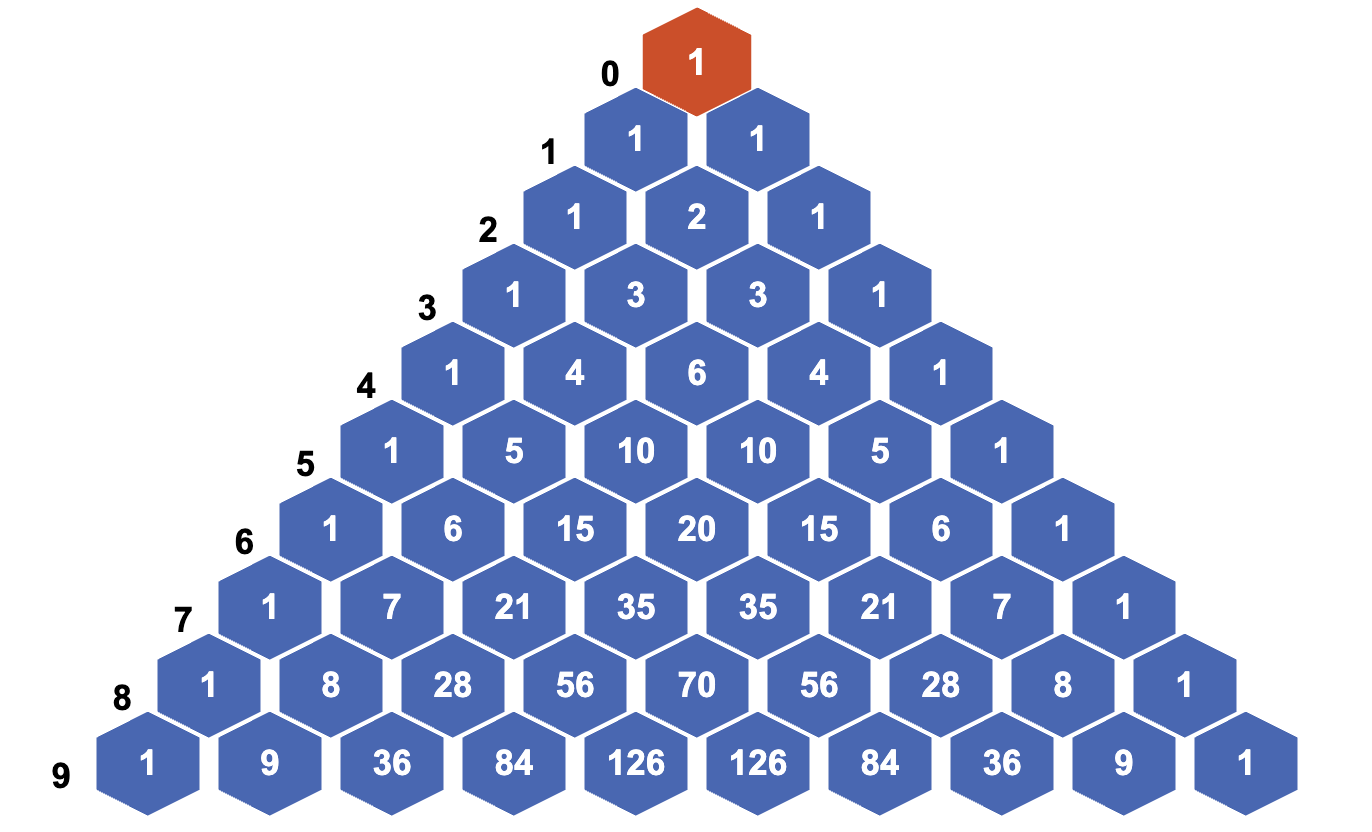
A figure demonstrating the first 10 rows of Pascal’s triangle, with row numbers in black and to the left.
Why Pascal’s triangle?
Pascal’s triangle in (most) of the West, but
In Iran, it’s called Khayyam’s triangle after the Persian mathematician Omar Khayyam
In China, it’s called Yang Hui’s triangle after the Chinese mathematician Yang Hui
In Italy, it’s called Tartaglia’s triangle after the Italian mathematician Niccolò Tartaglia
Try it yourself 1
Here’s something you can figure out.
Try it yourself 1
Using the defining relation and the figure above, work out the eleventh row of Pascal’s triangle. Write down any observations you have about the triangle so far.
A figure demonstrating the first 10 rows of Pascal’s triangle, with row numbers in black and to the left.
Answer to try it yourself 1
The next row should be \[1\;\; 10\;\; 45\;\; 120 \;\; 210 \;\; 252 \;\; 210 \;\; 120 \;\; 45 \;\; 10 \; \;1\] where each term is obtained by adding the two terms directly above it.
You can also notice that
every row is symmetric down the middle (and therefore so is the triangle)
every even numbered row has a unique number in the centre
every odd numbered row has two numbers the same in the middle.
there is \(1,2,3,4,5,6,\ldots\) down the diagonals in numerical order.
Sequences hidden in Pascal’s triangle
What’s a sequence?
A sequence is any finite or infinite list of numbers.
Any number in a sequence is called a term.
The term in position \(n\) of the sequence is called the \(n\)th term of the sequence.
What could some examples of sequences be?
Properties of sequences
Here, \((1)\) is a finite sequence with five terms; all of the others \((2)-(6)\) are infinite sequences - which you can see by the three dots \(\ldots\) at the end of each.
As evidenced by \((2)\), every term in the sequence can be the same; such a sequence is called a constant sequence.
Sequence \((3)\) shows that a sequence doesn’t have to follow a prescriptive pattern; they really can be any list of numbers.
Sequences \((3)\) and \((4)\) show that the order of the terms in the sequence matters; these are not the same sequence.
Sequence \((5)\) is an example of a sequence where the \(n\)th term is given by a formula involving \(n\).
Sequence \((6)\) is an example of a sequence where the \(n\)th term is given by some combination of previous terms. It can be defined by setting the first and second term to be \(1\), and then every subsequent term is the sum of the previous two terms. (This is the famous Fibonacci sequence.)
What’s the point?
Sequences of numbers help to measure growth of things. Knowing which sequences grow faster than others is a critical skill in measuring the speed of computer algorithms, as well as behaviour of some mathematical objects approach infinity.
Triangular numbers (1/3)
Looking down the diagonals of Pascal’s triangle (in either direction) gives infinite sequences of numbers.
The diagonal starting at row \(0\) (the side of the triangle) gives an infinite sequence of \(1\)’s, which is pretty boring.
The diagonal starting at row \(1\) gives the sequence of positive whole numbers \(1,2,3,4,5,\ldots\), which is more interesting.
The diagonal starting at row \(2\) gives the sequence \[1,3,6,10,15,\ldots\]
Triangular numbers (2/3)
Because of the way that Pascal’s triangle is created, you can get the terms of the sequence from the two entries above it: \[\begin{aligned} 1&=1\\[0.5em] 3 &= 1 + 2\\[0.5em] 6 &= 3 + 3 \\[0.5em] 10 &= 6 + 4\\[0.5em] 15 &= 10 + 5\\[0.5em] \vdots & \qquad \vdots\end{aligned}\]
But you can notice that the first terms of these sums are the sequence on the left, allowing you to write \[\begin{aligned} 1&=1\\[0.5em] 3 &= 1 + 2\\[0.5em] 6 &= 1 + 2 + 3 \\[0.5em] 10 &= 1 + 2 + 3 + 4\\[0.5em] 15 &= 1 + 2 + 3 + 4 + 5\end{aligned}\]
Triangular numbers (3/3)
You can visualize these numbers by triangles, where each term of the sum is the number of dots in a subsequent row.
This sequence of numbers is therefore called the triangular numbers.
The \(n\)th term of a triangular number is written as \(T_n\), so you could write \[T_1 = 1,\; T_2 = 3,\; T_3 = 6,\; T_4 = 10,\; T_5 = 15,\;\ldots\]
Formulas
You have already seen that you can get the \(n\)th triangular number \(T_n\) by adding \(n\) to the previous triangular number \(T_{n-1}\); so \[T_n = T_{n-1} + n.\]
However, mathematicians (yourself included) shouldn’t be satisfied with this. Using this formula, to work out the \(100\)th triangular number, you need to work out the previous \(99\).
Is there a way to work out the \(n\)th term of the sequence without working out all of the previous \(n-1\) terms? This is the same question as asking - is there a formula for the \(n\)th triangular number?
Formula for \(n\)th triangular number
The answer is yes:
Formula for \(n\)th triangular number
The formula for the \(n\)th triangular number is given by \[T_n = \frac{n(n+1)}{2}.\]
Next, you need to prove that this is true. It’s all well and good saying that something is true, but you need to be able to back that claim up.
In maths, this is done by starting with an assumption, following a series of logical steps until you get to a conclusion. Here, the assumption is that \(T_n = 1 + 2 + 3 + \ldots + n\) and the conclusion is that \(T_n = \frac{n(n+1)}{2}\).
History time: Gauss and his teacher
Tip
According to history, this problem was solved by Carl Friedrich Gauss at the age of seven years old when he realized that you can work out \(1 + 2 + 3 + \ldots + n\) by reversing the order of the sum to get \(n + (n-1) + \ldots + 2 + 1\) and adding to get \(n\) lots of \((n+1)\):
\[\begin{array}{cccccccccccc}& T_n & = & 1 & + & 2 & + & 3 & + & \ldots & + & n \\[0.5em] + & T_n & = & n & + & (n-1) & + & (n-2) & + & \ldots & + & 1\\[0.5em]\hline & 2T_n & = & (n+1) & + & (n+1) & + & (n+1) & + & \ldots & + & (n+1)\end{array}\]
You can then rearrange to get \(T_n = n(n+1)/2\) as you have already seen.
To do this at the age of seven gave a small hint of the genius to follow!
Square numbers
It’s all well and good to place two triangular numbers together to make a rectangle - can you get squares instead?
As it turns out, you can. You need to add the \((n-1)\)th triangular number to the \(n\)th to get a square shape, so you can reasonably deduce that:
Formula for \(n\)th square number
\[n^2 = T_n + T_{n-1}\]
Proof of formula for \(n\)th square number
Formula for \(n\)th square number
\[n^2 = T_n + T_{n-1}\]
Once again, you need to back up this statement with a proof.
You can approach this proof in two ways. You could use a geometric argument or you could do some algebra.
Try it yourself 2
In fact, this formula does a lot more than connect squares and triangles. This tells you explicitly that square numbers are always larger than triangular numbers for \(n>1\):
Try it yourself 2: formula comparing
Show that \(n^2 > T_n\) for \(n > 1\).
Answer to try it yourself 2
Answer to try it yourself 2
You know that \(n > 1\) and so \(n\geq 2\). This means that \(n - 1 \geq 1\) and so \(T_{n-1}\) is a positive integer. It follows from there that \(n^2 - T_{n-1} < n^2\). Since \(T_{n} = n^2 - T_{n-1}\) from above, it follows that \[T_n = n^2 - T_{n-1} < n^2\] and the result follows.
What’s the point?
Triangular numbers are used in two quite disparate areas:
If you are running a sports/gaming league with \(n\) teams/players/things in it, the amount of matches required so that every competitor plays every other competitor exactly once is \(T_{n-1}\).
Triangular numbers are used in accounting to calculate the depreciation of assets over a period of years.
Square numbers \(n^2\) are the start of investigation of polynomial growth. A sequence has polynomial growth if the \(n\)th term of the sequence can be expressed as some polynomial expression with largest term \(n^k\). Since the sequence of triangular numbers can be expressed by \((n^2 + n)/2\), this sequence has polynomial growth.
Tetrahedral numbers (1/3)
You can continue working your way down the diagonals of Pascal’s triangle. What if you start your diagonal at row \(3\)? You get the sequence of numbers: \[1,\; 4,\; 10,\; 20,\; 35,\; \ldots\] In the same way as the triangular numbers, using the defining property of Pascal’s triangle you can write each of these as \[\begin{aligned} 1&=1\\[0.5em] 4 &= 1 + 3\\[0.5em] 10 &= 4 + 6 \\[0.5em] 20 &= 10 + 10\\[0.5em] 35 &= 20 + 15\\[0.5em] \vdots & \qquad \vdots\end{aligned}\]
Tetrahedral numbers (2/3)
But you can notice that the first terms of these sums are the sequence on the left, allowing you to write \[\begin{aligned} 1&=1\\[0.5em] 4 &= 1 + 3\\[0.5em] 10 &= 1 + 3 + 6 \\[0.5em] 20 &= 1 + 3 + 6 + 10\\[0.5em] 35 &= 1 + 3 + 6 + 10 + 15\end{aligned}\] These are consecutive triangular numbers added together! In fact, much in the same way you can organise triangular numbers into triangles, you can organise these into stacks of triangles - tetrahedrons. So these are called tetrahedral numbers \(Te_n\), and are defined by the formula \[Te_n = Te_{n-1} + T_n.\]
Tetrahedral numbers (3/3)
There is also a closed form formula which you can prove geometrically (but suggest you don’t), given by \[Te_n = \frac{n(n+1)(n+2)}{6}.\]
Notice that there is an \(n^3\) term in here - this signifies a shift to three dimensions, and also that tetrahedral numbers grow faster than both triangular and square numbers, but still have polynomial growth.
Interlude: Fibonacci numbers (1/3)
Here’s a neat thing hiding in Pascal’s triangle.
Left-align Pascal’s triangle.
Starting in the left-most column of \(1\)’s, add up entries in diagonals in the northeast direction.
You should get the sequence \(1,1,2,3,5,8,13,21,\ldots\), which is the famous Fibonacci sequence.
The Fibonacci sequence \(F_n\) is defined by the following relation: \[F_0 = 1,\quad F_1 = 1,\quad F_n = F_{n-1} + F_{n-2}.\]
Interlude: Fibonacci numbers (2/3)
The Fibonacci sequence is everywhere in mathematics and nature:
The Fibonacci sequence is closely related to the golden ratio \(\varphi = (1 + \sqrt{5})/2 = 1.618\ldots\), which appears in art as the proportion of the golden rectangle
In biology, flowers tend to grow a Fibonacci number of petals as opposed to any other type of number
In genetics, the number of possible ancestors on an X chromosome line is a Fibonacci number
In computer science, Fibonacci numbers provide ‘worst case scenarios’ for the Euclidean algorithm and working out continued fractions.
Interlude: Fibonacci numbers (3/3)
How fast does the Fibonacci sequence grow? Well, a closed form formula for the Fibonacci numbers is \[F_n = \frac{\left(\frac{\sqrt{5} + 1}{2}\right)^n + \left(\frac{\sqrt{5}-1}{2}\right)^n}{\sqrt{5}}\] and so this is actually not polynomial growth, as it’s to a power of \(n\) rather than \(n\) to the power of something.
Try it yourself 3
Try it yourself 3
Add up each row of Pascal’s triangle in turn, and write up your answers. What do you get?
Answer to try it yourself 3
Note
Here’s a table of the answers.
| Row number | \(0\) | \(1\) | \(2\) | \(3\) | \(4\) | \(5\) | \(6\) | \(7\) | \(8\) | \(9\) |
|---|---|---|---|---|---|---|---|---|---|---|
| Sum of numbers in row | \(1\) | \(2\) | \(4\) | \(8\) | \(16\) | \(32\) | \(64\) | \(128\) | \(256\) | \(512\) |
Here, the sum of numbers in row \(n\) is twice the sum of numbers in row \(n-1\). Since row \(0\) sums to \(1\), it follows that the sequence of sums of numbers in rows are precisely the powers of two.
A proof of this try it yourself will be seen in the next presentation…
Powers of 2
Powers of two, powers of \(c\)
The sequence of numbers given by \(p_0 = 1,\quad p_n = 2\cdot p_{n-1}\) are the powers of two, with \(n\)th term given by \(p_n = 2^{n}\). Here, the notation \(2^n\) means \[2^n = 2\cdot 2\cdot 2\cdot\ldots\cdot 2\] where the product on the right consists of \(n\) many \(2\)s.
More generally, if \(c\) is any positive number, then the sequence of numbers given by \[c_0 = 1,\quad c_n = c\cdot p_{n-1}\] are the powers of \(c\), with \(n\)th term given by \(c_n = c^{n}\).
Tip
Here, the convention is to start the sequence at \(0\) rather than \(1\), as the first term is obtained by adding the numbers in row \(0\) of Pascal’s triangle.
Comparing
How do the powers of two compare to the square numbers? Are they bigger, or smaller? Well, comparing the two seems to suggest that powers of two are smaller than square numbers to begin with (for \(n = 1,2,3\)), are equal at \(n = 4\), but quickly overtake for larger \(n\). In fact, you can make the statement:
Sequence comparing 1
\(2^n > n^2\) for \(n > 4\).
Prove it!
How could you show this? The idea is to take the ratio of the two sequences, using the mathematical principle that is \(a,b\) are positive numbers with \(a < b\), then \(a/b < 1\). Then, by investigating how the ratio changes as \(n\) changes, you’re able to determine the behaviour of the sequences.
What’s the point?
The sequence of powers \(c^n\) of any number \(c > 1\) can be used to describe exponential growth. For instance, bacteria that split in half every \(24\) hours are an example of exponential growth.
Conversely, the sequence of powers \(c^n\) of any number \(0 < c < 1\) can be used to described exponential decay - which is particularly useful when it comes to management of nuclear waste.
In fact, for any positive number \(k\), there is a large enough number \(m\) such that \(2^n > n^k\) for all \(n > m\). This means that exponential growth is always eventually faster than polynomial growth.
Factorials
As you saw earlier, adding up the first \(n\) numbers gives you the \(n\)th triangular number \(T_n\). What happens when you multiply the first \(n\) numbers together?
Factorials
For a positive whole number \(n\), the number \(n!\), called \(n\) factorial, is defined to be \[n! = 1\cdot 2 \cdot 3\cdot \ldots \cdot (n-1)\cdot n\] which is the first \(n\) whole numbers multiplied together.
You can define a sequence of factorials by \[f_0 = 1,\quad f_n = f_{n-1}\cdot n\] So it follows that \[(n+1)! = (n+1)\cdot n!\] for all natural numbers
Try it yourself 4
Try it yourself 4
Starting at \(n = 0\), work out the first \(7\) factorials up to \(6!\).
Answer to try it yourself 4
Here’s a table of the answers.
| number \(n\) | \(0\) | \(1\) | \(2\) | \(3\) | \(4\) | \(5\) | \(6\) |
|---|---|---|---|---|---|---|---|
| \(n\) factorial \((n!)\) | \(1\) | \(1\) | \(2\) | \(6\) | \(24\) | \(120\) | \(720\) |
You can notice that \(n!\) starts to grow extremely quickly.
Factorial growth
How quickly? The answer is: quicker than exponential growth.
Sequence comparing 2
\(n! > 2^n\) for \(n > 3\).
Again, the idea is to take the ratio of the two sequences.
Growth again
In fact, you can show that for any positive number \(c\), there is a large enough number \(m\) such that \(n! > c^n\) for all \(n > m\). This means that factorial growth is always eventually faster than exponential growth. The exact \(m\) can be obtained using something called Stirling’s approximation.
Growth of sequences
Try it yourself 4
Try it yourself 4
Fill in the following table of sequences to give a full comparison of their properties. For fun, there is also a column for the super-exponential sequence \(n^n\).
| \(n\) | \(T_n\) | \(n^2\) | \(F_n\) | \(2^n\) | \(n!\) | \(n^n\) |
|---|---|---|---|---|---|---|
| 0 | \(0\) | undef | ||||
| 1 | ||||||
| 2 | ||||||
| 3 | ||||||
| 4 | ||||||
| 5 | ||||||
| 6 | ||||||
| 7 | ||||||
| 8 | ||||||
| 9 | ||||||
| 10 |
Answer to try it yourself 4
| \(n\) | \(T_n\) | \(n^2\) | \(F_n\) | \(2^n\) | \(n!\) | \(n^n\) |
|---|---|---|---|---|---|---|
| 0 | \(0\) | \(0\) | \(1\) | \(1\) | \(1\) | undef |
| 1 | \(1\) | \(1\) | \(1\) | \(2\) | \(1\) | \(1\) |
| 2 | \(3\) | \(4\) | \(2\) | \(4\) | \(2\) | \(4\) |
| 3 | \(6\) | \(9\) | \(3\) | \(8\) | \(6\) | \(27\) |
| 4 | \(10\) | \(16\) | \(5\) | \(16\) | \(24\) | \(256\) |
| 5 | \(15\) | \(25\) | \(8\) | \(32\) | \(120\) | \(3125\) |
| 6 | \(21\) | \(36\) | \(13\) | \(64\) | \(720\) | \(46556\) |
| 7 | \(28\) | \(49\) | \(21\) | \(128\) | \(5040\) | \(823543\) |
| 8 | \(36\) | \(64\) | \(34\) | \(256\) | \(40320\) | \(16777216\) |
| 9 | \(45\) | \(81\) | \(55\) | \(512\) | \(362880\) | \(387420489\) |
| 10 | \(55\) | \(100\) | \(89\) | \(1024\) | \(3628800\) | \(10000000000\) |
Try it yourself 5
Try it yourself 5
Explain why \(n^n > n!\) for all \(n > 1\).
Answer to try it yourself 5
You can see that \(n > k\) for all \(k = 1,2,\ldots,n-1\). Therefore, since \(ac < bc\) for all positive numbers \(a,b,c\) with \(a<b\), it follows that
\[ \begin{aligned} n! &= 1\cdot 2 \cdot 3 \cdot \ldots \cdot (n-1) \cdot n\\[0.5em] &< n\cdot n \cdot n \cdot \ldots \cdot n \cdot n\\[0.5em] &= n^n \end{aligned} \]
and this is enough.
Desmos time
Computational complexity
What’s the point?
So far, you have seen for all \(n > 4\) (at least) \[T_n < n^2 < 2^n < n! < n^n\] In fact, some of these sequences are the cornerstone of computational complexity, which is the study of how fast computer programs run.
Computational complexity (1/3)
Nowadays, computer programs underpin every facet of our lives. From shopping online, to gaming, to the financial markets, to transporting goods up and down the country, they really are everywhere.
The mathematical basis for computer programs is the study of algorithms. An algorithm takes in an input or inputs, performs a series of computational steps, and gives an output. The speed of an algorithm is measured in the number of computational operations inside the algorithm, and amount of these computational operations tend to scale with the size of the input. In other words, the number of computational operations is a sequence in which you are trying to minimize the growth rate.
Computational complexity (2/3)
Measuring the amount of these computational operations is typically written in something called big-O notation, and this notation measures the computational complexity of the algorithm.
For instance, if an algorithm has input of size \(n\) and needs (roughly) \(n^2\) many computational operations to complete, you would say that the complexity of the algorithm is \(O(n^2)\).
Computational complexity (3/3)
The smaller the growth rate of the sequence, the better the algorithm’s performance. Typically, you would want an algorithm to complete in polynomial time; that is \(O(n^k)\) for some positive number \(k\).
However, there are some algorithms (like the famous travelling salesman problem) that require at least exponential time \(O(c^n)\) (for some \(c > 1\)) to complete.
P versus NP (1/4)
Suppose that you are given a puzzle to solve, like a Sudoku. An algorithm could help you with this problem in one of two ways:
- given an attempt at a solution as an input, it could check your solution for you, or
- given the empty puzzle as an input, it could solve the puzzle for you.
You can categorise this in the following way:
- Problems with algorithms that solve that problem in polynomial time are said to be in the computational complexity class P.
- Problems with algorithms that can check a solution in polynomial time are said to be in the computational complexity class NP.
P versus NP (2/4)
Here are some examples of problems in each complexity class:
P
- Testing to see if a given number is prime or not
- Calculating the highest common factor of any two integers
- Sorting a set of inputs into an ordered list
- Wikipedia racing; going from one Wikipedia page to another in the fewest amount of clicks
NP
- Finding all prime factors of a given integer
- The travelling salesman problem
- Finding a group of people on Facebook who are all friends with each other
- Games and puzzles including Sudoku, Battleships, Tetris, and Super Mario Bros
- Creating a perfect Bitcoin block
P versus NP (3/4)
However, because humanity hasn’t yet found algorithms that solve the problems in NP in polynomial time, it doesn’t mean they don’t exist. (You can compare this to the existence of extra-terrestrial life, or of the Loch Ness monster.) This is one of the most significant open problems in theoretical computer science, the P vs NP problem:
If the solution to a problem can be checked in polynomial time, must the problem be solvable in polynomial time?
P versus NP (4/4)
If the solution to a problem can be checked in polynomial time, must the problem be solvable in polynomial time?
If the answer is yes (implying that P = NP), then humanity will have some significant issues to overcome. For instance, internet security relies on the fact that ‘finding all prime factors’ is not in P - so if it is, then a whole new security protocol will need to be invented. If the answer is no, then there will always be hard bounds on what computers can achieve.
A solution either way will net you a cool million dollars and make you famous for ever.
[Note: All of this framework is for regular computers - however, due to the fundamentally different nature of quantum computers, this problem might even be moot in a few years time…]
End
See you tomorrow :)